
If you’ve spent any time managing email authentication, you’ve probably had a run-in with SPF. That might have been a marketing team asking IT to add one more sender or a bounce report that didn’t make sense. Or maybe it was a DMARC report showing authentication failures for email you were pretty sure was legitimate.
Regardless of your entry point, SPF has a way of becoming everyone’s least favorite DNS record: quietly fragile, easy to break, and surprisingly hard to fix for good.
The problem isn’t that SPF is a bad protocol. It’s that SPF was designed for a simpler world, one where organizations sent email from a handful of known servers.
Today, the average company uses dozens of sending platforms (CRMs, marketing automation, ticketing systems, HR platforms, transactional email services), and that list keeps changing.
SPF was never built to handle that kind of sprawl.
Most organizations simply turn to SPF flattening. And that’s where things get interesting.
The real SPF problem (it’s not just the lookup limit)
The SPF 10-lookup limit gets most of the attention, and it’s a real constraint. When a receiving mail server checks your SPF record, it’s only allowed to follow up to 10 DNS lookups to resolve your authorized senders. Exceed that, and your SPF record returns a permerror — this means it fails entirely, even for mail you actually sent.
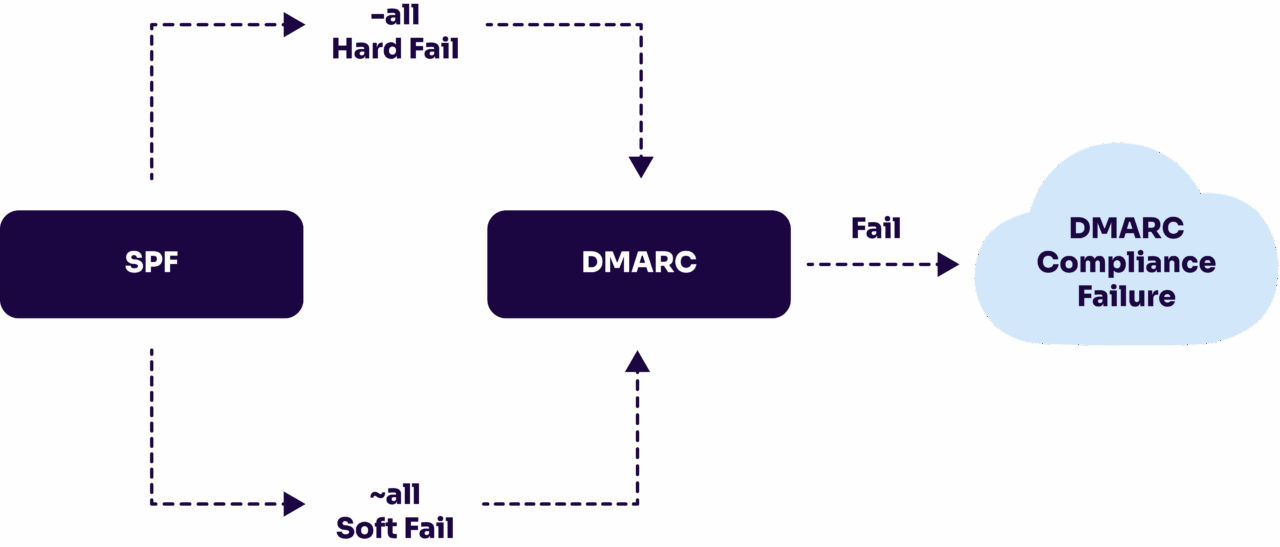
Still, the lookup limit is really a symptom of a deeper issue. The harder problem is IP address management.
Every third-party sending service you use resolves to a set of IP addresses. Those IPs change. Providers update their infrastructure, add new ranges, retire old ones, and your SPF record has no way of knowing.
If a service you’ve authorized shifts its sending IPs and you haven’t updated your record to match, mail from that service starts failing. Not because of anything you did wrong, but because the ground shifted under your feet.
This is why organizations with lots of senders (or senders that change frequently) can’t treat SPF as a set-it-and-forget-it configuration. It’s a living record that requires ongoing maintenance.
Most teams just don’t have the bandwidth for that.
SPF flattening: a solution that creates new problems
SPF flattening is the most common workaround for the lookup limit. Instead of using include: statements that require additional lookups to resolve, you flatten all those includes into a single list of IP addresses.
One lookup, problem solved.
Except it isn’t.
The moment you flatten your SPF record, you’ve created a static snapshot of a dynamic reality. Your sending services are still changing their IPs. Your record isn’t.
Over time (sometimes quickly, sometimes slowly), that gap widens. Legitimate email starts failing authentication. And the fix that was supposed to solve your SPF problem has quietly introduced a new one.
Flattening breaks something important: your include: relationships. When you use include:sendgrid.net in your SPF record, you’re trusting Twilio SendGrid to maintain its own SPF record and keep it up to date.
When you flatten, you bypass that.
You pull their IPs directly into your record, and that means you’re now responsible for keeping up with their infrastructure changes. That’s a maintenance burden you’ve unknowingly taken on, and it compounds every time you add a new sender.
The ordering problem most people overlook
The order of your SPF lookups matters.
When a mail server evaluates your SPF record, it processes the mechanisms in order, from left to right, and stops at the first match. That means if you have a high-volume sender buried toward the end of your record and the server hits the 10-lookup limit before reaching it, those emails fail (even if you authorized that sender).
It’s not just about how many lookups you have. It’s about which lookups happen first.
A record that looks compliant on paper can still cause authentication failures for legitimate mail, depending on which services hit the limit in any given evaluation. This is one of the reasons SPF failures can be so inconsistent and hard to diagnose — some mail passes, some fails, and you can’t always figure out why.
How SPF automation fixes the problem
The core problem with SPF is that you’re asking humans to maintain a technical dependency that changes faster than any team can reasonably track.
Valimail’s Instant SPF® takes a different approach entirely.
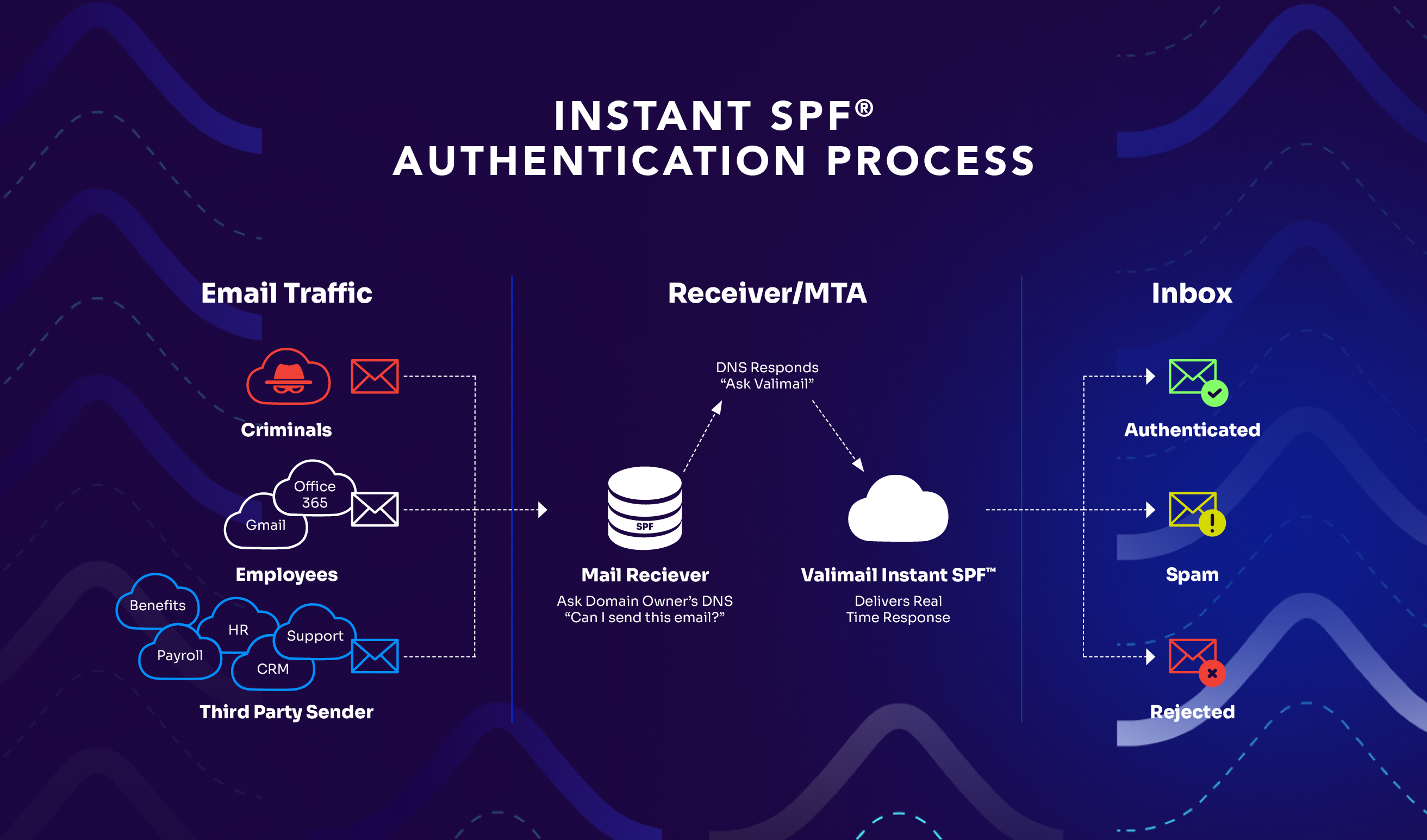
Rather than flattening IPs into your record or asking you to manually manage includes, Instant SPF abstracts the fragile logic away from your DNS record altogether. Your SPF record stays clean and compact.
Under the hood, Valimail handles the resolution — dynamically, in real time, with no DNS changes required on your end.
This means:
- No more lookup limit issues. Instant SPF supports unlimited SPF lookups without requiring flattening or include gymnastics.
- No more stale IP addresses. Because the resolution happens dynamically, your authorized senders are always current.
- No more manual updates. When you add a new sending service in Valimail, your SPF is updated automatically. No ticket to IT, no DNS change window, and no risk of a typo taking down your email.
- Your record stays private. Traditional SPF records are public and expose your entire sending infrastructure to anyone who looks. Instant SPF keeps your sender relationships private, which reduces your attack surface.
There’s also a security dimension to manual SPF that doesn’t get enough attention.
SPF records are public. Attackers read them. They look for overly permissive includes, abandoned services, and trust relationships you might have forgotten about.
A service you authorized two years ago and never revoked is still a potential vector. With automation, those lingering relationships get surfaced and cleaned up rather than quietly accumulating risk.
Ultimately, the goal is to make SPF something you don’t have to think about constantly while still being confident it’s working.
Check your SPF status (and get protected)
Not sure where your SPF record stands? Use Valimail’s free domain checker to see your current authentication status and spot potential issues before they become delivery problems.
Check your
domain now
Enter your domain to see if it’s vulnerable to spoofing or if others are sending emails on your behalf. Instantly check your DMARC, SPF, and BIMI status with a detailed security report.
You’re not fully protected, learn more here.
Check your
domain now
Enter your domain to see if it’s vulnerable to spoofing or if others are sending emails on your behalf. Instantly check your DMARC, SPF, and BIMI status with a detailed security report.
You’re not fully protected, learn more here.
Check your
domain now
Enter your domain to see if it’s vulnerable to spoofing or if others are sending emails on your behalf. Instantly check your DMARC, SPF, and BIMI status with a detailed security report.
You’re not fully protected, learn more here.
Your Domain
Not protected AGAINST IMPERSONATION ATTACKS
DMARC NOT AT ENFORCEMENT
exampledomain1.com
Authentication Status for January 10, 2025
DMARC at Enforcement
SPF Record Configured
BIMI Ready
exampledomain1.com
Authentication Status for January 10, 2025
DMARC at Enforcement
SPF Record Configured
BIMI Ready
And if you’re ready to go beyond visibility and actually fix the problem, Valimail Enforce includes Instant SPF out of the box. No flattening, manual DNS updates, or chasing down stale IP addresses.
Just SPF that works, and keeps working, even as your sending infrastructure changes.
Frequently asked questions about SPF flattening
Why does flattening break my SPF includes?
SPF flattening replaces your include: statements with the raw IP addresses they resolve to. This bypasses the sending service’s own SPF record, meaning you’re now responsible for keeping their IPs current in your record. When providers update their infrastructure (which they do regularly), your flattened record goes stale and legitimate mail starts failing.
Is Instant SPF the same as SPF flattening?
No. Flattening creates a static list of IPs that requires constant manual updates and breaks as sending infrastructure changes. Instant SPF is a patented technology that dynamically resolves your authorized senders in real time, without requiring DNS changes or manual maintenance. It removes the fragility that makes flattening a temporary fix rather than a real solution.
Why does the order of my SPF record matter?
Mail servers evaluate SPF mechanisms from left to right and stop at the first match. If you have high-volume senders listed toward the end of your record, there’s a real chance the server hits the 10-lookup limit before reaching them. This causes those emails to fail even though you’ve technically authorized the sender.
Can a single typo in my SPF record really cause email failures?
Yes, and it happens more often than you’d think. A mistyped include statement, an extra space, or a missing mechanism can cause SPF to fail silently for part or all of your email traffic. Because SPF records are managed manually in DNS, small errors are easy to introduce and hard to catch, especially when multiple teams have touched the record over time. Automation removes this risk entirely by keeping record management out of human hands.