Email authentication does a lot of important work that nobody sees. SPF, DKIM, and DMARC operate entirely behind the scenes to verify sender identity, block unauthorized mail, and protect your domain from impersonation.
When everything is working, your recipients have no idea any of it is happening. They just get your email. That’s the way it should be.
Security doesn’t need to be visible to be effective. But it does create a problem when you need to justify ongoing investment in authentication infrastructure, or when your marketing team asks what they’re getting out of all this DNS work.
BIMI (Brand Indicators for Message Identification) is the answer to that problem. It takes the authentication work you’ve already done and makes it visible in the form of your brand logo appearing next to every email you send. It’s the payoff (one of them) for the hard work of getting to DMARC enforcement, and it creates value that extends well beyond the security team.
Still, BIMI eligibility and BIMI success are two very different things, and that gap is where most organizations get stuck.
What BIMI is (and why it matters)
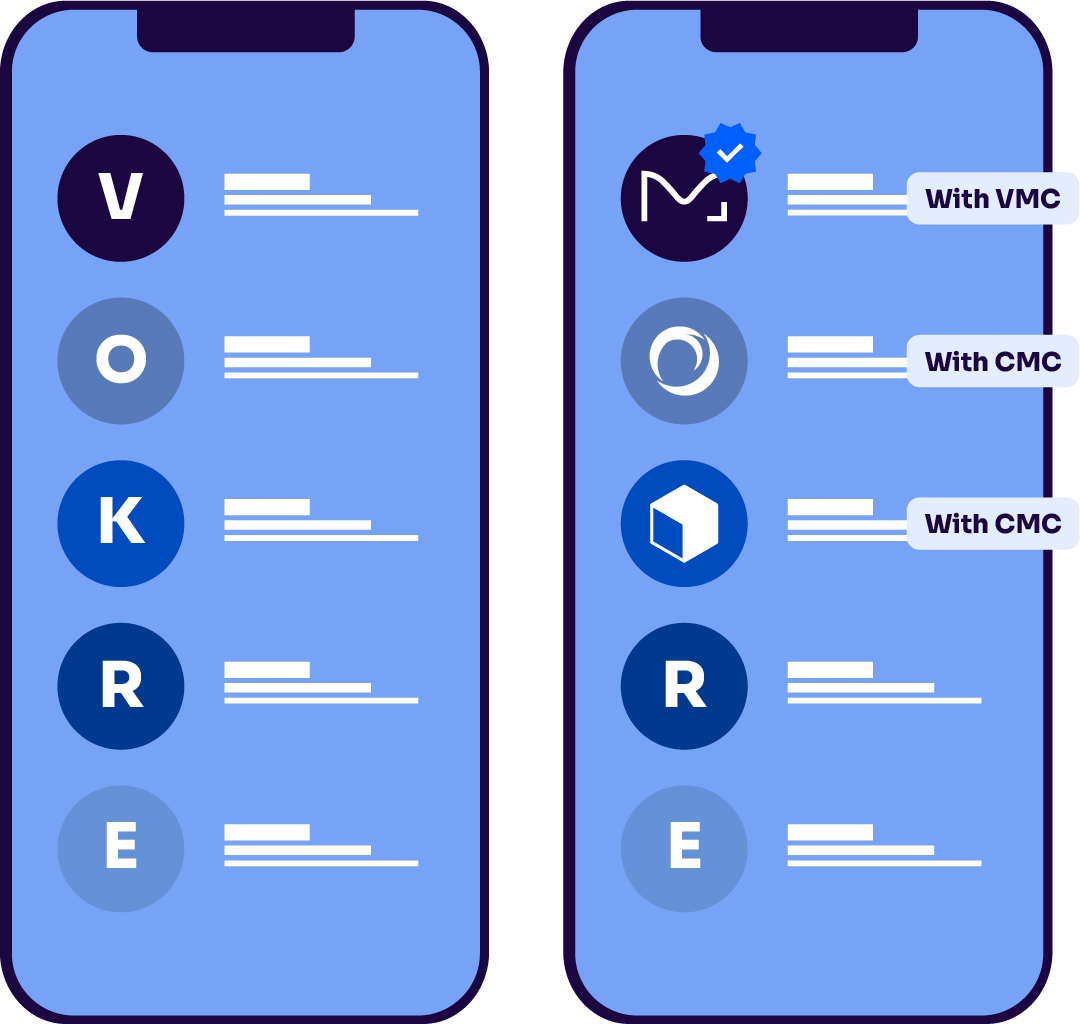
BIMI is an email standard that lets organizations display their brand logo next to authenticated email messages in supporting inboxes. When a recipient opens their Gmail, Yahoo, or Apple Mail app and sees your logo sitting next to your email in the inbox list, that’s BIMI at work.

Our CEO helped establish the BIMI Working Group in 2014, and our CTO still co-chairs it today. We didn’t just adopt BIMI…we helped build it.
For recipients, BIMI provides an immediate visual signal that an email is genuinely from the organization it claims to be from. For senders, it’s a way to stand out in a crowded inbox, reinforce brand recognition, and build trust at the exact moment someone is deciding whether to open your email.
What it takes to be BIMI-eligible
BIMI has a hard prerequisite: your domain must be at DMARC enforcement. Specifically, your DMARC policy needs to be set to either p=quarantine or p=reject. A p=none policy doesn’t work.
This requirement exists because BIMI is designed to work alongside strong authentication. The logo is only displayed when the sending domain can be verified with a high degree of confidence.
Most major inbox providers also require a Verified Mark Certificate (VMC) or a Common Mark Certificate (CMC) to display your logo with full verification.
- A VMC requires a trademark registration for your logo. It’s the certificate that unlocks Google’s blue checkmark verification alongside your logo.
- A CMC is a newer, more accessible option that doesn’t require trademark registration and is supported by a growing number of inbox providers.
Getting both the DMARC policy and the certificate requirements right takes coordination across IT, legal, and marketing teams, and that’s a big reason why so many organizations stall partway through the process.
Why eligibility doesn’t equal success
Most companies reach DMARC enforcement, hear about BIMI, look into it, and then nothing happens for months. That’s because the gap between eligibility and full BIMI implementation is more than just paperwork:
- The VMC acquisition process involves trademark verification, certificate issuance, and DNS configuration.
- The BIMI record needs to be correctly formatted and published.
- Your logo needs to meet specific technical requirements.
Any one of these steps can stall the process if there’s no clear owner and no dedicated guidance.
Most DMARC vendors will tell you that you’re eligible for BIMI once you hit enforcement, but very few will help you get there. That’s a big difference, because eligibility that never converts into implementation delivers exactly zero value.
What BIMI delivers beyond security
It’s tempting to think of BIMI purely as a security feature — a visual indicator that an email is authenticated. And it is that. But the value it delivers extends beyond the security use case, which is what makes it such a good investment for organizations that have already done the hard work of reaching enforcement.
Brand engagement and open rates
When your logo appears next to your email in the inbox, it does something that no other email security feature does: it makes your brand visible before the email is even opened. Recipients recognize your logo before they read your subject line. That recognition builds trust, and trust drives engagement.
It’s one of those rare instances when compliance becomes a competitive advantage rather than a security checkbox.
And the data shows it makes a difference. Emails with a brand logo displayed via BIMI see open rates increase by around 20% on average. For high-volume senders, that’s a major lift on top of campaigns that were already performing.
One food and beverage company that implemented BIMI through Valimail Amplify saw its open rates climb from 53% to 63%. That’s a massive improvement, and it persisted well beyond the initial launch period.
There’s also a brand impression angle that’s easy to overlook. Every email you send to a Gmail or Yahoo inbox is an opportunity for your logo to appear in front of a recipient (whether they open the email or not). At scale, that’s billions of brand impressions generated by the email volume you’re already sending.
The incremental cost is zero, but the incremental reach is impressive.
Making the ROI case for authentication
It’s hard to measure the merit of email authentication because its value is dependent on things that don’t happen:
- Phishing attacks that were blocked
- Spoofing attempts that failed
- Brand impersonation that never reached your customers
Yes, that’s genuinely valuable, but it’s hard to put on a slide for leadership. BIMI changes that equation, though.
Now, your authentication investment has a visible, measurable output:
- Logo impressions
- Open rate improvement
- Click-through rate improvement
- Unsubscribe rate decreases
- Brand trust signals that marketing can point to
This turns your security investment into a business enabler rather than a cost center. That matters for sustaining cross-team buy-in and keeping authentication on the priority list long after the initial enforcement project wraps up.
How Valimail Amplify gets you from eligible to live
Valimail Amplify is the only fully automated BIMI solution on the market, and it’s designed to close the gap between eligibility and real implementation.
For organizations already at DMARC enforcement, Amplify handles the entire BIMI process — from evaluating your readiness to managing the certificate path with DigiCert, activating your BIMI record, and validating that your logo is displaying correctly across supported inboxes.
You don’t have to coordinate between IT, legal, and marketing to figure out who owns which piece of the process. Amplify handles it.
Amplify helps beyond implementation, too:
- Multiple brand entities, domains, and logos: If your organization operates multiple brands or sends from multiple domains, Amplify lets you manage all of them from a single platform by assigning the right logo to the right domain and swapping them in and out as needed.
- VMC and CMC guidance: Valimail will help you figure out which certificate is right for your situation and manage the acquisition process from start to finish.
- Ongoing management: Certificates expire, logos change, and new domains get added. Amplify keeps everything current, so your logo keeps showing up where it should.
Getting to DMARC enforcement is the hard part. BIMI is the part where your hard work starts paying dividends (and now everyone in your organization can see them).
See what BIMI could look like for your brand
Valimail Monitor includes a free BIMI Simulator that lets you see what your logo would look like in the inbox before you commit to implementation. You can even check whether your competitors have BIMI enabled.
And when you’re ready to take action, Valimail Amplify works alongside Valimail Enforce to take you from DMARC enforcement to full BIMI implementation with less coordination, less complexity, and a faster path to results. See for yourself with a demo.
Frequently asked questions
Do I need a trademark to implement BIMI?
It depends on which certificate you’re pursuing. A Verified Mark Certificate (VMC) requires a registered trademark for your logo. A Common Mark Certificate (CMC) is a newer option that doesn’t require trademark registration and is supported by a growing number of inbox providers. Valimail can help you determine which certificate is right for your organization.
What’s the difference between BIMI eligibility and BIMI success?
BIMI eligibility means your domain meets the prerequisites, but BIMI success means your logo is displaying in supported inboxes. This requires a correctly configured BIMI record, a valid VMC or CMC, a properly formatted logo file, and correct DNS publication. Many organizations are eligible but never complete the implementation. Valimail Amplify is designed specifically to close that gap.
Does BIMI work with multiple brands or domains?
Yes, and managing multiple brands or domains is one of the areas where Valimail Amplify provides the most value. You can assign different logos to different domains, manage multiple brand entities from a single platform, and update or swap logos as needed without having to reconfigure your BIMI setup from scratch each time.