
For global enterprises, email authentication is not a single domain project. It is a governance challenge that spans regions, subsidiaries, brands, and business units. Large organizations often manage hundreds or even thousands of domains, each with its own sending infrastructure, vendors, and operational ownership. What appears manageable at a small scale becomes exponentially complex at enterprise scale.
Corporate domains coexist with regional domains, product domains, legacy domains from acquisitions, and campaign-specific subdomains. Different teams operate independently across geographies. Vendors are onboarded locally. Infrastructure varies between business units. In this environment, maintaining consistent SPF, DKIM, and DMARC policies across the entire domain estate is not simply a technical task. It is an organizational coordination problem.
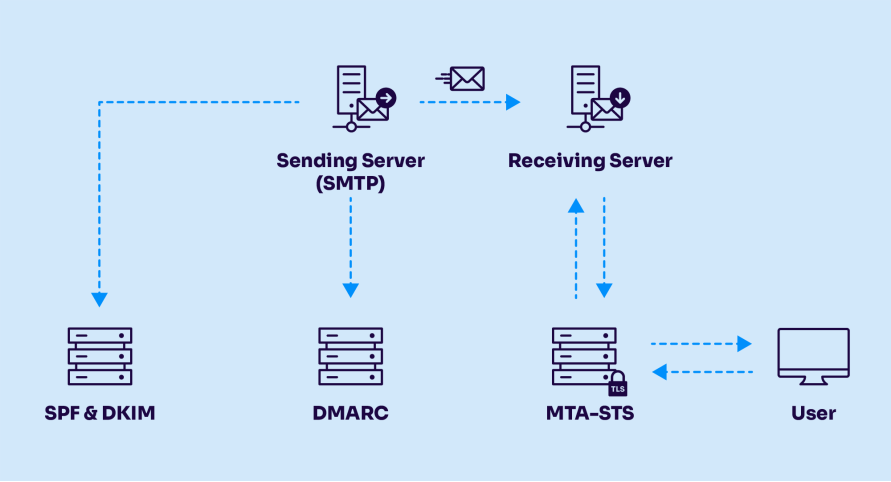
Without centralized visibility and governance, authentication gaps emerge. These gaps create compliance risks, weaken domain reputation, and open the door to spoofing and impersonation attacks targeting executive leadership, subsidiaries, and regional brands. For large enterprises, the question is not whether to implement email authentication, but how to manage it consistently and at scale across a global footprint.
The multi-domain challenge in global enterprises
Large enterprises rarely operate under a single domain. Over time, organizations accumulate domains through product launches, regional expansions, mergers and acquisitions, and brand segmentation. It is not uncommon for a global enterprise to manage hundreds of active domains and thousands of subdomains.
These domains often serve different purposes. Some are corporate domains used for executive and employee communication. Others belong to regional subsidiaries with their own IT teams and vendors. Product domains may power customer notifications, marketing campaigns, or SaaS platforms. Legacy domains from acquisitions may still send transactional email years after integration.
The challenge is that authentication maturity varies widely across this estate. One region may have enforced DMARC with strong DKIM practices, while another operates in monitoring mode with limited visibility. Some subsidiaries may rely on local vendors that are not centrally approved. Others may have inherited infrastructure that no longer has clear ownership.
Without centralized governance, there is no consistent view of who is sending email across the organization. Each domain may appear compliant in isolation, but collectively, the enterprise lacks unified control. This fragmentation increases risk because attackers often target the weakest link in a domain portfolio, not the strongest one.
Managing email authentication across multiple domains, therefore, requires more than configuration. It requires enterprise-wide visibility, standardized policy frameworks, and a governance model that spans regions and business units.
SPF becomes significantly more complex as organizations scale. In a global enterprise, email is sent from corporate infrastructure, regional data centers, cloud platforms, marketing automation systems, customer support tools, billing providers, and numerous SaaS applications. Each of these services must be explicitly authorized in SPF records.
SPF at enterprise scale
At a small scale, maintaining SPF may involve a handful of entries. At enterprise scale, SPF records can quickly become overloaded. The DNS lookup limit of ten mechanisms creates operational risk, especially when multiple vendors include nested SPF references. Exceeding this limit causes legitimate email to fail authentication, often intermittently and without clear visibility.
Global organizations also face coordination challenges. A regional team may add a vendor locally, updating SPF for one domain but not others. A corporate security team may standardize policies centrally without realizing that a subsidiary relies on a unique sender. Over time, SPF records become fragmented, flattened inconsistently, or duplicated across subdomains without governance.
Vendor sprawl further complicates matters. Large enterprises often work with dozens of third-party providers across marketing, HR, finance, and operations. Each vendor may require SPF authorization, and any change in vendor infrastructure can break authentication if not managed carefully.
At enterprise scale, SPF management is no longer a static configuration task. It becomes an ongoing operational discipline. Without centralized oversight and automated visibility into sending behavior, SPF drift and misconfiguration are inevitable, increasing both deliverability risk and exposure to impersonation attacks.
Coordinating DKIM across multiple systems
While SPF often becomes overloaded at scale, DKIM introduces a different type of complexity. DKIM relies on cryptographic key pairs that must be generated, published in DNS, and properly aligned with sending domains. In a global enterprise with dozens of platforms and regional teams, coordinating DKIM consistently is a significant operational challenge.
Each vendor may use its own key generation process. Some require customers to publish public keys manually. Others rotate keys periodically. In large organizations, it is common to find outdated keys still published in DNS, inconsistent key lengths, or platforms signing with domains that do not align with the visible From address.
Key rotation policies further complicate the landscape. Security best practices recommend periodic DKIM key rotation, but without centralized coordination, rotation schedules vary across business units. A vendor may update infrastructure without notifying central IT, leading to authentication failures that impact specific regions or product lines.
Alignment is also a frequent issue. DKIM signatures may pass technically, but if the signing domain does not match or align with the visible From domain, DMARC will still fail. In decentralized environments, subsidiaries may configure DKIM independently, resulting in inconsistent alignment policies across the enterprise.
At scale, DKIM management requires governance, documentation, and monitoring. Without centralized visibility into which keys are active, how they are configured, and whether they align correctly, authentication becomes fragile. Small configuration changes in one region can create deliverability issues or security gaps across the global domain estate.
Check your
domain now
Enter your domain to see if it’s vulnerable to spoofing or if others are sending emails on your behalf. Instantly check your DMARC, SPF, and BIMI status with a detailed security report.
You’re not fully protected, learn more here.
Check your
domain now
Enter your domain to see if it’s vulnerable to spoofing or if others are sending emails on your behalf. Instantly check your DMARC, SPF, and BIMI status with a detailed security report.
You’re not fully protected, learn more here.
Check your
domain now
Enter your domain to see if it’s vulnerable to spoofing or if others are sending emails on your behalf. Instantly check your DMARC, SPF, and BIMI status with a detailed security report.
You’re not fully protected, learn more here.
Your Domain
Not protected AGAINST IMPERSONATION ATTACKS
DMARC NOT AT ENFORCEMENT
exampledomain1.com
Authentication Status for January 10, 2025
DMARC at Enforcement
SPF Record Configured
BIMI Ready
exampledomain1.com
Authentication Status for January 10, 2025
DMARC at Enforcement
SPF Record Configured
BIMI Ready
DMARC policy management across a domain estate
Managing DMARC across a global enterprise is not simply about publishing records. It requires coordinating policy decisions across hundreds of domains that may have different risk profiles, business owners, and levels of authentication maturity.
In many enterprises, some domains operate in p=none for visibility, others may be in p=quarantine, and a small subset have reached p=reject. This inconsistency creates uneven protection across the domain portfolio. Attackers often target less mature domains, including regional or product-specific properties that lack enforcement.
Standardizing DMARC policies across a domain estate requires clear governance. Central security teams must define enterprise-wide authentication standards while allowing flexibility for regional operations. Subsidiaries may need time to remediate authentication gaps before enforcement can be applied safely.
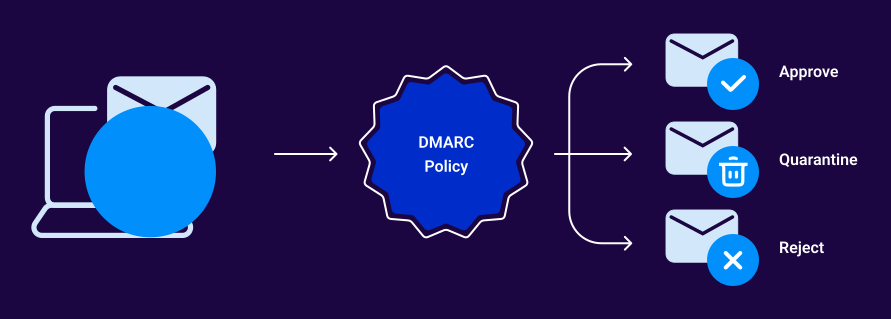
The complexity increases further when dealing with subdomains. Enterprises often delegate subdomain management to business units or external vendors. Without centralized monitoring, subdomain policies can drift or remain unenforced, weakening overall protection.
Moving a global organization from monitoring to enforcement is therefore a phased, at-scale initiative. It requires visibility into authentication readiness across all domains, coordinated remediation, and clear communication between corporate security and regional IT teams. Without centralized oversight and automation, enforcement paralysis is common, leaving the enterprise exposed despite significant effort.
Acquisitions, mergers, and domain expansion
For global enterprises, mergers and acquisitions introduce some of the most significant authentication challenges. Each acquisition typically brings its own domain portfolio, vendors, sending infrastructure, and authentication maturity level. Integrating these assets into a centralized authentication framework is rarely straightforward.
Newly acquired domains often operate in p=none or lack DMARC entirely. SPF records may be overloaded or misconfigured. DKIM keys may be outdated or unmanaged. In some cases, there is no clear documentation on which systems send email or who owns the configuration.
The risk during this transition period is substantial. Attackers frequently target newly acquired brands because they know integration efforts are underway and controls may not yet be fully aligned. Spoofing attempts against regional or recently acquired domains can damage both the subsidiary brand and the parent organization’s reputation.
Reputation spillover is another concern. Mailbox providers evaluate domains individually, but brand perception is shared globally. If a newly acquired domain suffers from poor authentication and abuse, customers often associate that experience with the broader enterprise.
Effective integration requires rapid discovery of all sending sources, validation of SPF and DKIM alignment, and a clear roadmap toward standardized DMARC enforcement. Without centralized visibility and automation, onboarding acquired domains becomes a prolonged manual effort that leaves gaps in protection.
Regional compliance and regulatory considerations
Global enterprises must manage email authentication not only for security and deliverability, but also for compliance. Different regions operate under different regulatory frameworks, and email often carries sensitive customer, financial, or healthcare information that is subject to strict oversight.
Data protection laws increasingly require organizations to demonstrate strong controls around data integrity and protection against fraud. Email authentication supports these controls by reducing the risk of impersonation, credential harvesting, and unauthorized communications that could expose regulated data.
Industry-specific regulations add another layer of complexity. Financial institutions, healthcare providers, and government contractors face additional scrutiny around identity verification and incident reporting. Weak authentication across any domain within the enterprise estate can lead to audit findings or reputational damage.
Audit readiness at enterprise scale requires centralized reporting. Security and compliance teams must be able to show where DMARC is enforced, how authentication coverage is measured, and how unauthorized sending is detected and remediated.
By treating email authentication as part of the enterprise compliance framework rather than a regional IT task, organizations strengthen both their security posture and their ability to demonstrate control to regulators, auditors, and customers worldwide.
Deliverability and brand protection at global scale
For global enterprises, email authentication directly impacts deliverability and brand reputation across markets. When hundreds of domains send email worldwide, mailbox providers evaluate trust at both the domain and infrastructure levels. Inconsistent authentication across regions weakens overall reputation.
Attackers frequently target executive domains, regional brands, and subsidiary properties because they are less monitored than primary corporate domains. Weak authentication on even a single domain creates an entry point.
Deliverability issues also multiply at scale. If one region misconfigures SPF or DKIM, authentication failures can reduce inbox placement for that specific domain. Over time, inconsistent behavior across the enterprise estate creates fragmented reputation signals with mailbox providers, leading to throttling or inconsistent inbox performance.
Global brand protection requires uniform identity control. Customers associate all communications with the enterprise brand. Ensuring consistent authentication across every domain reinforces trust and reduces the likelihood that impersonation attacks will succeed.
Governance and operational models for enterprise authentication
Managing authentication across a global domain estate requires a clear governance model. Without defined ownership and accountability, even well-designed policies fail at execution.
Some enterprises adopt a centralized model, where a global security team owns authentication across all domains. Others operate under a federated model, where regional teams manage domains within defined enterprise standards.
In both models, domain ownership mapping is critical. Every domain and subdomain should have a clearly identified business owner, technical contact, and defined policy state.
Enterprise authentication governance must also include change management processes. New vendors, campaigns, acquisitions, and infrastructure updates all affect authentication.
Continuous monitoring replaces periodic audits as the foundation of governance. At enterprise scale, static documentation is insufficient. Authentication posture must be measured in real time across all regions and business units.
Why manual management fails at enterprise scale
Manual DNS updates, vendor coordination, and periodic reviews cannot keep pace with the number of domains and infrastructure changes in global organizations.
Configuration drift accumulates. New vendors are added without oversight. DKIM keys expire. SPF limits are exceeded. Enforcement decisions are delayed because teams lack confidence in their visibility.
Without automation, generating a global view of authentication status requires aggregating data from multiple sources, and that view is outdated almost immediately.
At enterprise scale, authentication must be continuously monitored and governed centrally. Manual processes inevitably fall behind.
How automated, centralized platforms enable enterprise control
Automated, centralized platforms provide unified visibility across all domains and subsidiaries. Continuous sender discovery surfaces unknown services. Centralized policy governance ensures consistency across regions.
Enterprises can define global authentication standards while granting role-based access to regional teams. Automated readiness indicators enable safe enforcement at scale without risking disruption.
By combining visibility, governance, and automation, centralized platforms transform authentication from a fragmented regional effort into a coordinated global security control.
How Valimail supports global enterprises
Valimail provides centralized visibility across corporate domains, subsidiaries, product domains, and newly acquired properties. Continuous discovery identifies all sending sources across regions and business units.
Real-time monitoring of SPF, DKIM, and DMARC alignment eliminates blind spots. Role-based access supports distributed operational models while maintaining enterprise oversight.
Clear readiness indicators and automated policy management enable safe migration to p=reject across large domain portfolios. This ensures consistent enforcement, sustainable governance, and resilient protection.
Get started by monitoring your domain
Global enterprise email authentication is a governance challenge driven by scale, complexity, and organizational structure. Without centralized visibility and automation, fragmentation and drift are inevitable.
By standardizing policies, continuously monitoring authentication health, and enforcing governance across all domains, enterprises transform authentication into a durable global security control.
Automation and centralized oversight enable consistent enforcement, stronger compliance posture, improved deliverability, and resilient brand protection worldwide.
FAQs about global enterprise email authentication
How do global enterprises manage email authentication across multiple domains?
They use centralized visibility and governance models supported by automated platforms that provide continuous sender discovery, policy standardization, and scalable enforcement.
Why is authentication more complex for large enterprises?
Because enterprises manage hundreds of domains, subsidiaries, vendors, and regions, each with its own independent infrastructure and varying levels of maturity.
What are the biggest risks in multi-domain environments?
SPF overload, inconsistent DKIM alignment, shadow IT, unenforced domains, and inherited weaknesses from acquisitions.
How do acquisitions affect authentication?
Acquisitions introduce new domains and infrastructure that may lack proper controls, creating integration and reputational risks.
Why does manual management fail at scale?
Manual processes cannot keep pace with constant vendor changes, infrastructure updates, and regional autonomy, leading to configuration drift and enforcement delays.
How does Valimail support enterprise authentication?
Valimail provides centralized visibility, continuous discovery, automated authentication monitoring, and scalable DMARC enforcement across global domain portfolios.