Let’s be real: Email authentication shouldn’t require a DNS certification. But if your team has ever stared down a confusing TXT record or scratched their heads at a DMARC failure report, you know how quickly things can get complicated.
Most IT and security professionals understand the “why” of DMARC. It protects your domain from being used in phishing attacks. It gives you visibility into who’s sending on your behalf. And when properly enforced, it’s one of the most effective ways to protect your brand’s email reputation.
But the “how”? That’s where things break down.
You need to understand SPF, DKIM, alignment, reporting, enforcement policies, and oh yeah, not break anything your marketing team or vendors are sending. No pressure.
Here’s the thing: You don’t need to be a DNS expert to get DMARC right. You just need a partner who is.
Why DMARC feels harder than it should
DMARC (Domain-based Message Authentication, Reporting, and Conformance) is built on top of two other standards: Sender Policy Framework (SPF) and DomainKeys Identified Mail (DKIM). That means you’re working with a chain of dependencies, and if something breaks upstream, DMARC will fail too.
Here are a few of the most common pain points teams face:
1. SPF’s 10 DNS lookup limit
SPF checks authorized senders by looking up DNS records. But it can’t handle more than 10 lookups per check. Go over that limit, and your legitimate email starts failing SPF, and by extension, DMARC.
Unfortunately, many companies unknowingly exceed that limit by adding multiple third-party email services (think: Salesforce, Marketo, Mailchimp, etc.). Each of these adds DNS lookups, and if you’re not actively managing the record, you’ll likely hit a wall.
2. DKIM complexity
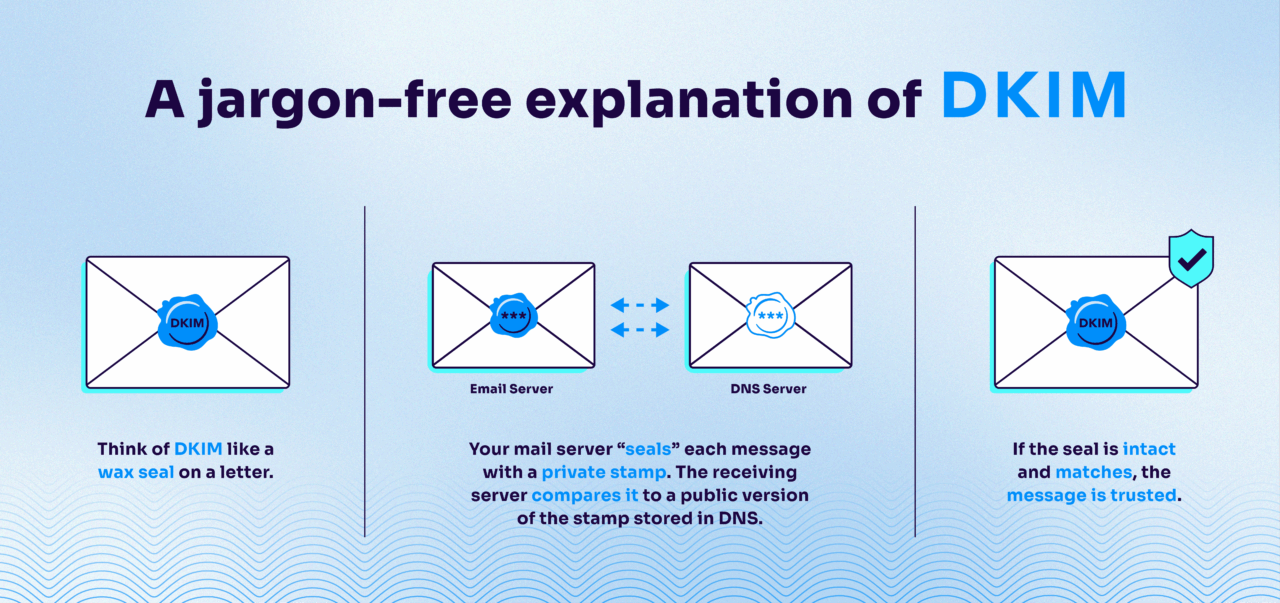
DKIM works by cryptographically signing messages with a private key that matches a public key stored in your DNS. Sounds straightforward, but…
- Keys expire
- DNS records get deleted
- Vendors rotate keys without warning
- Misalignment issues tank authentication
DKIM is powerful, but fragile, and requires constant maintenance and upkeep.
3. Misconfigured DNS
DNS is challenging to manage and unforgiving.
One misplaced character, one wrong policy setting, and suddenly your email delivery tanks.
4. Confusing DMARC reports
You finally publish a DMARC policy, and now you’re getting XML reports from hundreds of inbox providers. What are you supposed to do with that? How are you supposed to read the DMARC report?
Unless you’ve built a parser or hired someone to interpret those reports, it’s all just noise.
Pro tip: Valimail Monitor makes it easy to read DMARC reports and provides them in a readable format that lists all the senders by name.
5. No in-house expertise
Not every team has a dedicated email security engineer, let alone someone who understands the nuances of DNS authentication. You’re already stretched thin, juggling endpoints, firewalls, and identity access management. DNS is one more thing on a growing to-do list.
You don’t need DNS expertise, you need a guide
That’s where Valimail comes in.
We’ve helped over 92,000 organizations manage their DMARC, and we do it without requiring our customers to become email authentication experts.
Our solutions are built to make DMARC work for your team, not the other way around. Whether you’re just getting started or trying to push to enforcement, we help you:
- Discover all the third-party senders using your domain
- Resolve SPF and DKIM misalignment issues
- Avoid the 10 DNS lookup limit without custom scripting
- Read and act on DMARC reports in plain English
- Implement and enforce policies without breaking legitimate email
And here’s the part that sets us apart: our support team is with you every step of the way.
We don’t just toss documentation your way and hope for the best. Our team of experts guides you through deployment, monitors your progress, flags risky configurations, and helps troubleshoot sender issues as they come up. And if you need extra support and care to manage your complex DNS infrastructure? You can upgrade to our Valicare support packages.
Think of it as having a DNS expert on speed dial, without needing to add headcount.
What getting DMARC right actually looks like
When DMARC is done right, it’s a game-changer.
- Your domain can’t be spoofed anymore — no more exact-domain impersonation phishing.
- Your customers and partners trust your email because it’s authenticated.
- You gain visibility into every sender using your domain — legitimate or otherwise.
- Your brand is protected, and your risk of business email compromise (BEC) drops significantly.
Plus, achieving DMARC enforcement shows regulators, customers, and leadership that you’re serious about email security, and that your domain isn’t the low-hanging fruit attackers love to exploit.
Curious about the current status of your DMARC policy? Use Valimail’s free domain checker to get an idea of where you may have gaps in your security:
Check your
domain now
Enter your domain to see if it’s vulnerable to spoofing or if others are sending emails on your behalf. Instantly check your DMARC, SPF, and BIMI status with a detailed security report.
You’re not fully protected, learn more here.
Check your
domain now
Enter your domain to see if it’s vulnerable to spoofing or if others are sending emails on your behalf. Instantly check your DMARC, SPF, and BIMI status with a detailed security report.
You’re not fully protected, learn more here.
Check your
domain now
Enter your domain to see if it’s vulnerable to spoofing or if others are sending emails on your behalf. Instantly check your DMARC, SPF, and BIMI status with a detailed security report.
You’re not fully protected, learn more here.
Your Domain
Not protected AGAINST IMPERSONATION ATTACKS
DMARC NOT AT ENFORCEMENT
exampledomain1.com
Authentication Status for January 10, 2025
DMARC at Enforcement
SPF Record Configured
BIMI Ready
exampledomain1.com
Authentication Status for January 10, 2025
DMARC at Enforcement
SPF Record Configured
BIMI Ready
Valimail makes email authentication manageable
Valimail was the first to offer hosted DMARC, and we’ve continued to lead by turning complex DNS authentication into something that’s actually manageable.
We don’t treat email authentication like a side feature — it’s our entire focus. We built our platform and support model specifically for security and IT professionals who need:
- Clear guidance without jargon
- Solutions (not just “tools”) that keep working after launch
- Confidence that their DNS records and senders are always aligned
You don’t need to write regex or manually parse DMARC XML to get results. You just need a partner who’s done this before, thousands of times.
Ready to make DMARC simple?
If you’re ready to stop wrestling with SPF records, decoding DKIM, and dreading DMARC reports, it’s time for a better path forward.
Let’s take a closer look at your current email authentication setup. Our team will guide you through a customized consultation, showing you what works (and what doesn’t), and help you build a clear and safe path to enforcement.

FAQs on DNS expertise
What if our DNS team isn’t comfortable editing email authentication records?
You’re not alone; DNS is high-stakes. One malformed TXT record or missing semicolon can disable email for an entire domain. Valimail provides precise, copy-paste-ready DNS instructions and validates every change, so you don’t have to be a DNS expert to get it right. We help you avoid common pitfalls, such as duplicate records, misordered tags, and formatting issues, that can cause silent failures.
Q: How do you help diagnose DNS issues that cause SPF or DKIM to fail?
Many authentication failures originate in DNS, including unreachable include chains, malformed key records, incorrect record types, or broken CNAMEs. Valimail continuously checks your DNS for those issues, identifies exactly where the failure is happening, and flags the specific mechanism, selector, or DNS value causing the break. Instead of trial-and-error debugging, you get clear steps to fix the root cause.
Q: What if our DNS records take too long to propagate or differ between name servers?
Propagation delays and inconsistent name server responses can cause intermittent authentication failures — some receivers see an old record while others see the new one. Valimail monitors your published records across multiple global resolvers and alerts you if propagation or authoritative server issues may impact SPF, DKIM, or DMARC. This helps prevent temporary misalignment from becoming a persistent delivery problem.