Email is still the most common channel attackers use to impersonate trusted brands, steal credentials, and redirect payments. Because so many regulated communications begin or end in the inbox, email security is no longer just an IT concern. It’s a compliance concern that touches recordkeeping, privacy, consumer protection, and risk management. Across industries, regulators rarely mandate one specific email authentication protocol by name. Instead, they expect organizations to implement reasonable safeguards, maintain effective supervision and controls, and demonstrate that decisions are documented and revisited as threats evolve.
Email authentication, including SPF, DKIM, and DMARC, helps reduce spoofing by allowing receiving mail systems to verify whether a sender is authorized to send on behalf of a domain. When paired with monitoring and alerting, these protocols also become a practical way to detect lookalike domains, unauthorized third-party senders, and misconfigurations that can degrade deliverability or create opportunities for fraud. For many compliance teams, the challenge is not understanding the concepts, but mapping technical controls to regulatory expectations and proving that those controls are operating effectively.
Read on to learn how you can align authentication with supervision, privacy, and payment security requirements and how to translate mailbox-level risks into audit-ready controls.
How major regulations treat email security and authentication
Most compliance frameworks approach email security through outcomes rather than prescribing exact technical steps. The outcomes typically include protecting the confidentiality and integrity of sensitive information, reducing the likelihood of social engineering attacks, maintaining reliable records, and ensuring that vendors and third parties do not introduce unmanaged risk. Email authentication supports each of these outcomes in a way that is measurable and auditable.
SPF helps a domain owner publish which sending systems are allowed to send mail for that domain. DKIM adds a cryptographic signature to messages so that recipients can verify the message has not been altered in transit and that it aligns with the signing domain. DMARC ties these signals together and tells recipients what to do when mail fails authentication, while also generating reports that help the domain owner see who is sending mail using its domains. BIMI can further reinforce trust by displaying a verified logo in some inboxes, but it depends on strong authentication and policy alignment.
Regulators generally evaluate security controls using a risk-based lens. They want to see that an organization has identified plausible threats, such as spoofed emails leading to wire fraud, credential theft, or improper disclosure of personal information. They also want proof that controls are implemented consistently across the organization’s domains, including marketing platforms, customer support systems, and third-party vendors that send mail on the organization’s behalf. In practice, that means you need an inventory of sending sources, a way to validate authorization, and an enforcement strategy that reduces impersonation.
A key compliance theme is continuous monitoring. Email authentication is not a set-and-forget task. Business units adopt new tools, vendors rotate infrastructure, and acquisitions introduce new domains. If you can’t see new senders quickly, your SPF record may break, DKIM keys may be missing, or DMARC may be misaligned, creating both deliverability problems and security gaps. Many audit findings are less about the absence of a control and more about the absence of governance to keep the control effective.
Another common theme is documentation. For compliance, it isn’t enough to say “we use DMARC.” You should be able to explain the scope of domains covered, the policy level, the process for onboarding new senders, how exceptions are handled, and what alerts trigger investigation. This turns a technical deployment into a defensible program that aligns with multiple regulations at once.
FINRA and SEC broker-dealer expectations for email integrity and supervision
For broker-dealers and investment advisers, regulatory expectations often emphasize supervision, record retention, and the integrity of communications. While FINRA and SEC rules are not “DMARC rules,” email authentication directly supports the goals behind supervisory systems and controls by reducing impersonation risk and improving the reliability of messages that clients and employees receive.
A practical compliance mapping starts with the concept of safeguarding customer communications from fraudulent redirection. Spoofed emails can be used to deliver fake account notices, solicit credentials, or initiate fraudulent money movement instructions. Even if an organization maintains a strong archival and retention system, impersonation can still cause client harm and trigger reportable incidents. Authentication helps reduce the likelihood that fraudulent mail reaches client inboxes appearing to come from a legitimate domain.
Supervision expectations also imply that communications channels should be governed, not ad hoc. In email terms, that means knowing which domains are used for business communications and ensuring each is protected with consistent policies. It also means controlling third-party senders. Many firms rely on external platforms for newsletters, appointment reminders, and client portals. Without proper SPF authorization and DKIM signing aligned to the organization’s domain, recipients may see unauthenticated mail, and attackers can more easily imitate similar messages. A well-managed DMARC program forces clarity: either a sender is authorized and aligned, or it is not.
Recordkeeping can be indirectly affected by authentication too. When deliverability declines due to poor authentication, business units sometimes route mail through alternative accounts or consumer-grade channels to “get the message out.” That can create supervision and retention gaps. Establishing strong domain authentication reduces the operational pressure that leads to these workarounds.
From an examination standpoint, firms benefit from being able to demonstrate a living program: an up-to-date inventory of domains and subdomains, a register of authorized sending services, and monitoring evidence that identifies unauthorized mail streams. DMARC aggregate reports can help show visibility, while forensic and alert-driven workflows help show responsiveness. Policy progression is also important. A firm may start with a monitoring policy, but a mature program generally moves toward quarantine or reject for high-risk domains, with documented exceptions for business-critical senders and a process to remediate them.
Because regulated firms often operate in a high-risk fraud environment, email authentication should be paired with user awareness and transaction verification procedures. Authentication doesn’t stop lookalike domains, and it doesn’t prevent account compromise. However, it reduces direct domain spoofing, which is a common precursor to financial loss and a frequent element in client complaints and incident reviews.
HIPAA security rule considerations for email authentication and phishing risk
HIPAA’s Security Rule focuses on protecting electronic protected health information (ePHI) through administrative, physical, and technical safeguards. Email authentication isn’t called out explicitly, but it supports several Security Rule concepts: protecting the integrity of information, reducing the risk of unauthorized access, and implementing reasonable and appropriate security measures based on risk analysis.
Healthcare organizations and their business associates frequently use email for appointment communications, patient portal notifications, billing, and internal coordination. Even when the email body does not include ePHI, the message can be a gateway to ePHI through links, attachments, and credential prompts. Phishing is therefore not only an IT issue but a privacy and security issue because compromised credentials can lead to unauthorized access to systems containing ePHI.
Email authentication helps reduce the volume of successful spoofing attempts that impersonate a provider’s domain. A common attack pattern is sending a message that appears to come from a clinic or billing department, asking a patient to confirm information, pay a bill, or reset a password. When the receiving email system honors DMARC and the sender’s domain is set to enforce, these spoofed messages are more likely to be rejected or diverted. That risk reduction can be part of a documented risk management plan.
Integrity is another relevant HIPAA concept. DKIM provides message integrity in transit by allowing recipients to detect alteration. While DKIM does not encrypt content, it can help prevent certain tampering scenarios and can support trust in system-generated messages such as portal notifications.
HIPAA also emphasizes ongoing evaluation. Organizations should treat authentication as part of a continuous program that includes an inventory of domains used for patient-facing and staff-facing mail, governance over new sender onboarding, and routine review of DMARC reports. If a new vendor begins sending patient reminders from an unauthorized system, the organization should detect it quickly and correct alignment. This is particularly important when marketing and patient engagement tools are managed outside the core security team.
It’s also important to set realistic expectations. Authentication does not replace encryption for messages that contain ePHI, and it does not prevent all phishing. Attackers can use lookalike domains or compromise legitimate accounts. A HIPAA-aligned approach treats DMARC, SPF, and DKIM as part of layered defense along with multi-factor authentication, secure patient portals, endpoint protections, and training.
If a security incident occurs, the ability to show that reasonable anti-spoofing controls were implemented and monitored can be valuable when reconstructing events, reducing recurrence, and demonstrating a mature security posture to stakeholders.
GDPR and PCI DSS requirements where email security controls matter
Even for organizations primarily operating in the USA, GDPR can be relevant when handling personal data tied to individuals in the European context or when interacting with entities that contractually require GDPR-aligned controls. GDPR is principles-based, emphasizing appropriate security of personal data, protection against unauthorized processing, and confidentiality and integrity. Email authentication supports these goals by reducing the chance that attackers can impersonate a legitimate domain to trick recipients into disclosing personal data or logging into compromised portals.
Under GDPR’s security principle, organizations should implement measures appropriate to risk, including the ability to ensure ongoing confidentiality, integrity, availability, and resilience. Authentication contributes to integrity and resilience of communications channels, and DMARC reporting can provide evidence of ongoing monitoring. Another GDPR-relevant aspect is incident response. When phishing leads to credential theft and unauthorized access, breach assessment and notification may become necessary. Reducing spoofing and improving detection can lower the likelihood and impact of such incidents.
PCI DSS is more explicit about security controls for environments that store, process, or transmit cardholder data. While PCI DSS does not mandate DMARC, email is commonly used in payment-related workflows: invoices, receipts, customer support, and internal approvals. Phishing emails can be used to compromise accounts with access to payment systems, harvest credentials for remote access, or redirect payments through business email compromise. From a PCI perspective, these are pathways to compromise systems in scope for cardholder data, or to compromise the people who administer them.
PCI DSS emphasizes risk reduction through security awareness, access control, secure configuration, logging and monitoring, and incident response. Email authentication complements these by reducing spoofed messages that target staff with privileged access. It can also help protect customers from fraudulent payment links purporting to be from a merchant’s domain, which can reduce brand harm and support consumer trust.
In both GDPR and PCI contexts, third-party risk management is critical. Payment processors, marketing tools, and support platforms may send mail using an organization’s domain. Without strict authorization and alignment, a recipient may not be able to distinguish legitimate communications from malicious ones. A governance model that requires vendors to support DKIM signing, uses controlled SPF authorization, and enforces DMARC policies reduces this ambiguity.
A practical way to frame authentication for these frameworks is as an “email channel control.” Define ownership for domains, establish baselines for SPF, DKIM, and DMARC, require evidence that new senders align before going live, and maintain monitoring with defined response times. This turns a technical deployment into an operational control that can be tested, reviewed, and improved in line with GDPR and PCI expectations.
Strengthening compliance and authentication
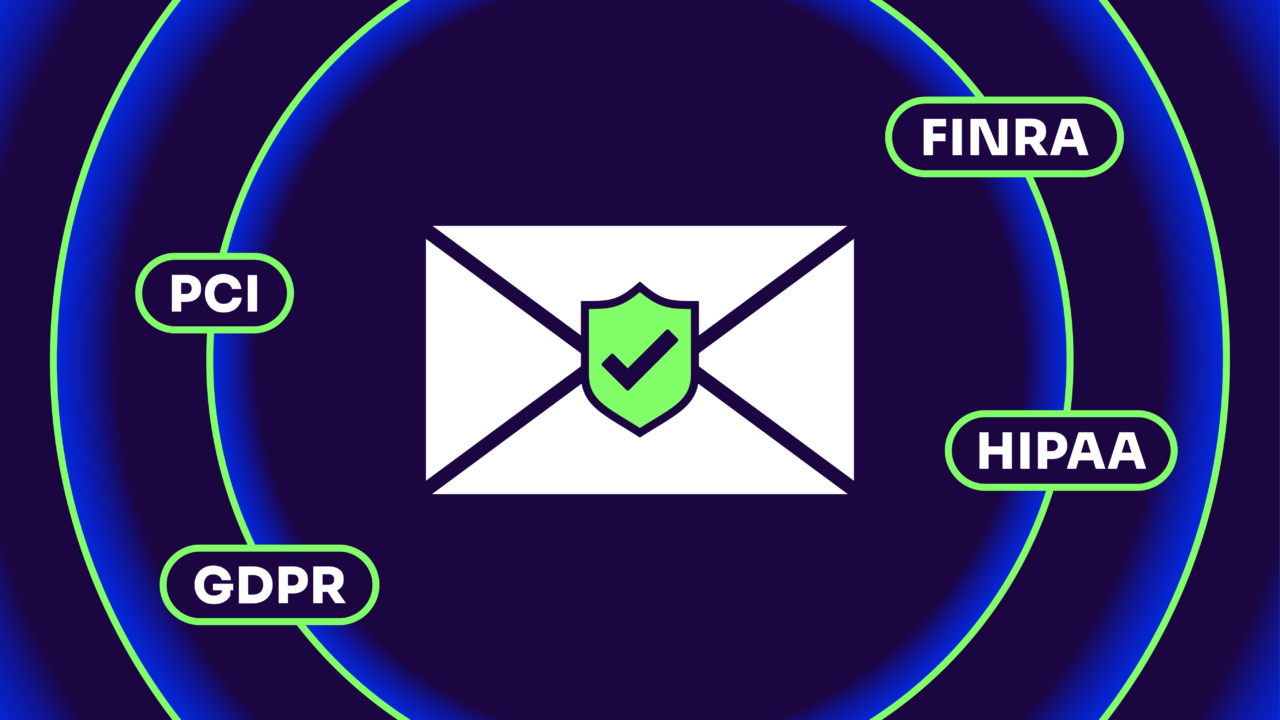
Compliance frameworks consistently expect reasonable controls that protect sensitive data, reduce fraud, and support effective governance and oversight. Email authentication fits naturally into those expectations because it addresses a persistent, high-impact risk: domain spoofing. While FINRA, HIPAA, GDPR, and PCI DSS approach security from different angles, they share common themes that email authentication can support, including integrity of communications, reduction of unauthorized access pathways, third-party risk management, and continuous monitoring with documented processes.
A defensible email authentication program goes beyond publishing records. It includes a complete inventory of domains and senders, consistent SPF and DKIM alignment, a DMARC policy strategy that progresses toward enforcement, and monitoring that surfaces risky or unexpected sources quickly. It also requires coordination across security, compliance, and business teams so that new tools and vendors do not create gaps. Authentication should be viewed as part of layered defense, complementing encryption where needed, access controls, security awareness, and incident response.
If you’re building or maturing an authentication program and need a structured way to gain visibility, automate remediation, and maintain ongoing oversight, you can try Valimail for free.
FAQs
How does DMARC help with compliance if regulators do not explicitly require it?
DMARC helps translate broad regulatory expectations into a concrete, testable control. Many regulations and frameworks focus on outcomes like preventing unauthorized access, maintaining integrity of communications, and reducing fraud risk. DMARC contributes by making it harder for attackers to spoof an organization’s exact domain in the “From” field, which is a common tactic in phishing and business email compromise. It also produces reporting that can be used to demonstrate monitoring and governance, which auditors often look for.
While DMARC doesn’t address every email threat, it can show that an organization has taken reasonable steps to secure a high-risk communication channel. The strongest compliance value comes when DMARC is paired with documented processes for sender onboarding, exception handling, and incident response tied to authentication failures and anomalous sending patterns.
What is the difference between SPF, DKIM, and DMARC, and why do compliance teams care?
SPF identifies which mail servers are allowed to send on behalf of a domain, helping receivers detect unauthorized infrastructure. DKIM adds a cryptographic signature so a receiver can verify that the message content has not been modified and that it is associated with a signing domain. DMARC connects these by requiring alignment between the visible “From” domain and the authentication results, and it instructs receivers how to handle failures.
Compliance teams care because each control supports risk reduction and accountability. SPF and DKIM without DMARC can still allow spoofing of the visible domain in some cases. DMARC adds enforcement and reporting, which supports governance. Together, they reduce spoofing risk, improve deliverability consistency for legitimate messages, and provide evidence that the organization actively manages email as a controlled business channel.
Does email authentication replace encryption or secure messaging for sensitive data like health or payment information?
No, email authentication and email encryption solve different problems. Authentication verifies that messages claiming to be from your domain are actually authorized and, with DKIM, that they have not been altered in transit. Encryption protects the confidentiality of message content.
For regulated data, such as ePHI or certain payment-related information, encryption or secure portals may be required by policy or risk analysis, even if authentication is strong. Authentication is still valuable because many compromises begin with phishing rather than direct interception of email content. By reducing spoofed emails and increasing trust in legitimate system notifications, authentication supports broader protection of sensitive workflows.
A sound approach is layered: authenticate domains, encrypt or portal-deliver sensitive content, enforce strong access controls, and maintain monitoring and training to address account compromise and social engineering.
What evidence can we provide to auditors to show email authentication is functioning as a control?
Useful evidence typically includes a domain inventory, configuration baselines, and monitoring outputs. Start with a list of all domains and subdomains used for business email, along with the current SPF records, DKIM selectors and key management approach, and DMARC policy and reporting destinations. Provide documentation of governance, such as a change management process for adding new senders and periodic review cadences. DMARC aggregate reporting trends can show that legitimate senders are aligned and that unauthorized sources are being rejected or quarantined. If you have alerting, retain samples of alerts and ticket workflows showing investigation and remediation. Also include vendor onboarding records demonstrating that third-party platforms are configured to sign with DKIM and align with DMARC. Auditors generally look for repeatable processes and proof of ongoing operation, not just one-time screenshots.
How should organizations handle third-party vendors that send email on their behalf?
Third-party senders are often where authentication programs fail, because business units add tools without centralized oversight. A practical approach is to require that vendors support DKIM signing using your domain or a controlled subdomain and that their sending infrastructure is authorized through SPF without over-broad inclusions. Establish an intake process where the vendor’s sending details are validated before production sending begins, and confirm DMARC alignment using test messages and report monitoring. Maintain a register of approved vendors and the domains they are allowed to use. When possible, separate high-risk communications, such as password resets or payment notices, onto domains with stricter DMARC enforcement and minimal vendor access. Finally, continuously monitor DMARC reports for new or unexpected sources. Treat unrecognized senders as potential incidents until verified, because attackers sometimes attempt to blend into legitimate vendor traffic.
If we set DMARC to reject, will it break legitimate email or disrupt operations?
It can, if you move to enforcement without completing sender discovery and alignment. A reject policy tells receivers to reject messages that fail DMARC checks, which is the intended security outcome for spoofing. But legitimate mail can fail if a vendor is not DKIM signing correctly, if SPF is misconfigured, or if forwarding scenarios cause failures without mitigation.
The safer path is phased: start with monitoring to identify all senders, fix alignment issues, then progress through quarantine to reject for domains where you have confidence. Use subdomains strategically to apply stricter policies to high-risk mail streams first. Monitor DMARC reports closely during transitions and establish a rapid response process to remediate false failures. Done carefully, enforcement improves both security and deliverability by signaling to mailbox providers that your domain is well managed.