Traditional phishing relied on volume. Send enough generic messages, and statistically, someone will click. It’s just a matter of time. The typos, obvious urgency, and generic greetings worked because the economics of spam favored quantity over quality.
Generative AI broke that model.
AI phishing attacks use large language models, deepfake technology, and publicly available data to generate phishing content that is:
- Personalized
- Grammatically flawless
- Contextually relevant to each target
The same volume that traditional phishing operated at is now achievable with content that reads like it came from your CEO, IT team, or bank because, effectively, it did.
Below, we’ll cover what AI phishing attacks are, how they work, what types exist, and why the defenses that worked against traditional phishing are unreliable against AI-generated threats.
What is AI phishing?
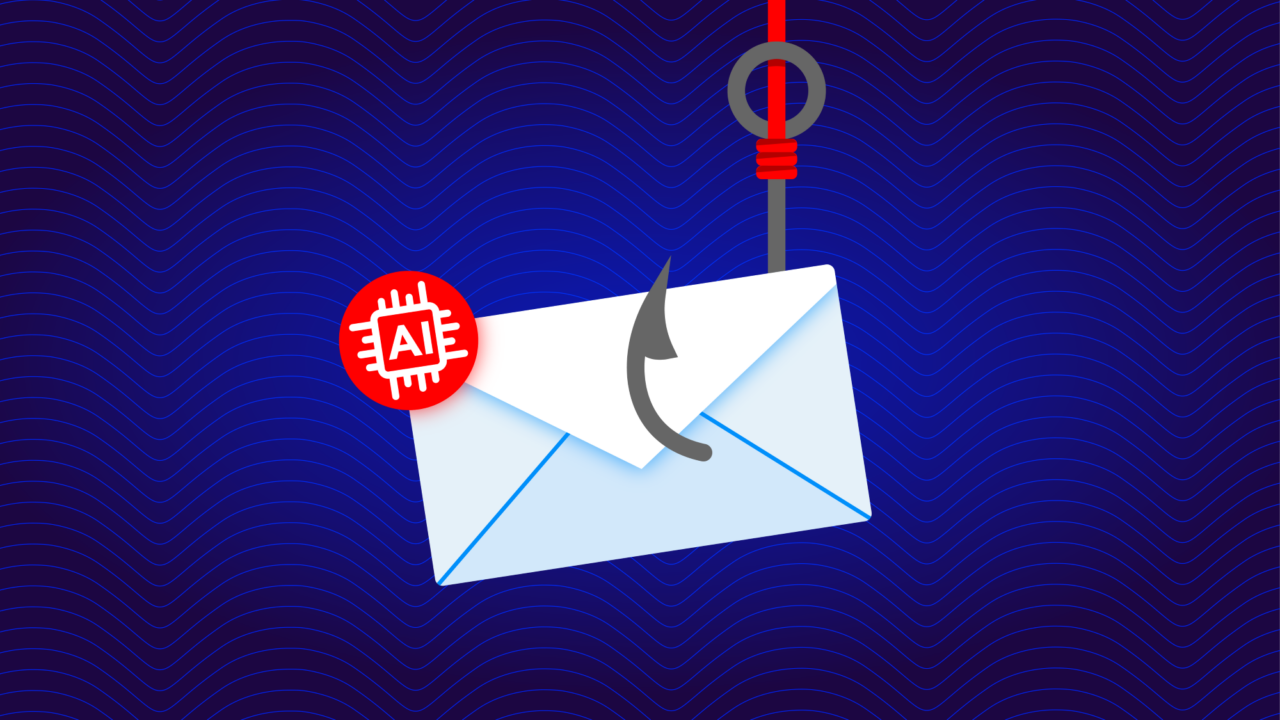
AI phishing uses artificial intelligence to generate phishing content that is more convincing, more personalized, and produced at greater scale than traditional methods allow.
A traditional phishing email might use a generic template (“Dear valued customer, your account has been compromised”), but an AI phishing email can reference your name, role, recent activity, colleagues, and your company’s communication style. All of this is pulled from publicly available data and assembled by a large language model (LLM) in seconds.
Better grammar isn’t the bigger threat here. It’s that AI removes the scaling tradeoff. Attackers no longer have to choose between reach and relevance. They can have both.
AI phishing vs. traditional phishing
The difference between AI-generated and traditional phishing goes beyond comsetics. It’s structural.
| Factor | Traditional phishing | AI phishing |
| Personalization | Generic — same message to thousands | Highly specific — tailored to each target |
| Content quality | Often poor grammar, obvious tells | Fluent, contextually accurate, tone-matched |
| Scale | High volume, low relevance | High volume, high relevance |
| Cost to attacker | Low | Low (AI tools are cheap and fast) |
| Detection difficulty | Moderate — spam filters catch patterns | High — content passes most automated checks |
| What it exploits | Volume and luck | Trust and familiarity |
The detection difficulty row is the one that matters most for security teams. Traditional phishing defenses like spam filters, user training to spot bad grammar, and content analysis all assume that phishing content looks different from legitimate email. AI phishing eliminates that assumption.
How AI phishing attacks work
The mechanics of an AI phishing attack follow a recognizable pattern, even as the specific tools change.
- Data collection. Attackers harvest publicly available information about their targets: LinkedIn profiles, company websites, press releases, social media posts, and email signatures. For targeted attacks, this data provides the raw material for personalization.
- Content generation. An LLM (like a variant of GPT or a purpose-built phishing tool) takes the collected data and generates a message that matches the target’s context. The output might be an email that references a specific project, mimics the writing style of a known colleague, or uses company-specific terminology. Tools like ChatGPT have made this accessible to attackers with no technical background.
- Delivery method selection. The attacker chooses how to send the message. Options include exact-domain spoofing (pretending to come directly from your company’s domain), lookalike domains (a registered domain that’s visually similar to yours), or compromised accounts (sending from a real, legitimate address that has been taken over). The content quality is the same regardless of delivery method, but the authentication status isn’t.
- Deployment at scale. What used to require manual effort per target is now automated. An attacker can generate hundreds of individually personalized phishing emails in the time it used to take to write one.
This leads to AI-assisted social engineering at a volume and quality that traditional attack methods could never reach.
Types of AI phishing attacks
AI doesn’t create a brand-new type of threat. Instead, it enhances several existing ones:
- AI-generated spear phishing. Spear phishing targets specific individuals with personalized content. AI makes this scalable. What previously required research hours per target can now be automated against hundreds of targets simultaneously.
- Deepfake phishing. Deepfake phishing goes beyond email into audio and video. Attackers create synthetic voice or video clips of executives or trusted colleagues and use them to add a second layer of verification to a phishing attempt. A CFO receiving an email asking for an urgent wire transfer, followed by a voice message that sounds exactly like the CEO, faces a fundamentally different threat than a text-only scam.
- AI-enhanced clone phishing. Clone phishing copies a legitimate email and replaces links or attachments with malicious versions. AI improves this by generating variations of the cloned content that pass automated detection.
- Business email compromise (BEC) with AI. BEC attacks impersonate executives or trusted partners to authorize fraudulent transactions. AI makes these more convincing by matching the impersonated person’s actual writing style, which attackers can train on by collecting legitimate emails through prior reconnaissance or account compromise.
- Chatbot-assisted credential harvesting. Some AI phishing campaigns use conversational AI on landing pages to interact with victims in real time, answering questions and adapting responses to maintain the deception. Rather than a static fake login page, the target encounters a responsive support agent that guides them through handing over their credentials.
Why traditional defenses fall short today
Most phishing defenses assume that phishing content is detectably different from legitimate email. AI phishing challenges that assumption, though, forcing modern-day defenses to look beyond the obvious signs.
Spam filters and content analysis look for patterns associated with phishing: unusual links, suspicious formatting, known phishing phrases, mismatched sender domains. AI-generated content doesn’t have these patterns. It’s structurally identical to legitimate email.
User training traditionally teaches people to spot bad grammar, generic greetings, and urgent language. These cues disappear with AI-generated content. Training programs that focus on content recognition need to shift toward behavioral anomaly detection and trust verification methods.
Secure Email Gateways (SEGs) use AI and machine learning to identify suspicious behavior and malicious payloads. They’re a massive part of a layered defense, and Valimail partners with leading SEG providers because the combination of authentication and content filtering is stronger than either alone. But SEGs have to guess at intent from content. When the content is indistinguishable from legitimate email, those guesses become less reliable.
AI phishing detection is a real and evolving discipline. But it’s a detection problem operating on content, and that’s exactly what AI attackers are optimizing to defeat.
How to defend against AI phishing attacks
No single layer stops AI phishing. The best approach combines authentication (which AI can’t forge) with content filtering, behavioral controls, and human awareness.
1. DMARC enforcement — the layer AI can’t fake
Domain-based Message Authentication, Reporting, and Conformance (DMARC) stops phishing attacks that rely on impersonating your domain. At p=reject, any email that fails authentication is blocked before delivery, regardless of how convincing the content is. AI can generate a perfect email, but it can’t forge a valid DKIM signature or pass SPF alignment checks for a domain it doesn’t control.
Ultimately, content-based defenses are vulnerable to content optimization, but authentication is a cryptographic check that doesn’t depend on how the email reads.
2. Layer authentication with SEGs
DMARC handles outbound impersonation to stop attackers from sending as your domain. SEGs handle inbound filtering by evaluating messages coming into your organization from external domains.
Both are necessary.
Valimail partners with leading SEG providers to provide authentication and content analysis that addresses different threat surfaces.
3. Retrain employees on behavioral signals
Employees should be alert to unusual requests regardless of how legitimate the email looks. They should be especially cynical of requests involving financial transactions, credential changes, or urgent executive directives. “
“Verify out of band” (call the person through a known number rather than replying to the email) remains the most reliable human defense against social engineering.
4. Implement multi-factor authentication (MFA)
Even if a credential is harvested through AI phishing, MFA creates a second barrier before an attacker can use it. Hardware security keys and authenticator apps are more resistant to phishing than SMS-based codes.
5. Monitor for lookalike domains
AI phishing often uses domains that appear visually similar to yours. Valimail’s Domain Lookalike Finder identifies lookalike domain registrations before they’re used in an attack.
What zero trust means for AI phishing
Zero trust email security means treating every sender as unverified until authentication proves otherwise, regardless of how legitimate the email looks or feels. This is the correct posture for an AI phishing environment, because content-based trust is exactly what attackers are exploiting.
DMARC enforcement operationalizes zero trust for email. It doesn’t evaluate content. It verifies identity.
When a message claims to come from your domain, DMARC checks whether the underlying authentication supports that claim. If it doesn’t, the message is blocked. Simple as that.
That’s not a guess. That’s a cryptographic verification. And it’s the one defense AI phishing can’t write its way around.
Valimail Monitor gives you free visibility into who’s sending as your domain right now. And Valimail Enforce automates the path to DMARC p=reject — the enforcement level that stops domain spoofing.
See for yourself. Sign up for Valimail Monitor for free, or book a demo with our team to get a hands-on walkthrough of DMARC automation in action.
Frequently asked questions
What is AI phishing?
AI phishing uses large language models and deepfake technology to generate phishing content that is personalized, contextually accurate, and produced at scale. This makes it far harder to detect than traditional phishing based on content alone.
How is AI phishing different from regular phishing?
Traditional phishing sends generic messages at high volume and accepts a low success rate. AI phishing generates highly personalized content at the same volume, dramatically improving the likelihood that a target will engage. The grammar is flawless, the context is accurate, and the message often references real details about the target.
Can AI detect phishing emails?
AI-based detection tools are a valuable part of a layered defense, but face a persistent challenge: AI phishing is optimized to produce content that passes automated checks. Authentication-based defenses like DMARC are more structurally reliable because they verify identity rather than evaluate content.
Does DMARC protect against AI phishing?
DMARC protects against AI phishing that impersonates your domain. At p=reject, any email failing authentication is blocked before delivery, regardless of how convincing the content is. It doesn’t stop lookalike domain attacks or compromised accounts, and that’s why pairing DMARC with domain monitoring and SEG filtering covers all three vectors.