Companies understand the importance of brand consistency. Nowadays, it’s not a foreign concept. Still, when your brand shows up everywhere from Instagram stories to customer support chats, keeping your look consistent might seem like trying to get everyone in a massive family to wear matching outfits for a holiday photo.
Possible? Yes. Easy? Not so much.
However, while most businesses spend countless hours perfecting their social media presence and website design, there’s one place where brand consistency often falls apart: the email inbox. You know, that place where you actually have your customers’ undivided attention.
That’s where BIMI (Brand Indicators for Message Identification) can help. Below, we’ll walk you through how BIMI can improve your brand consistency and help you show up uniformly across all channels.
Your brand in the inbox matters more than you think
While your customers might scroll past your social media posts or bounce off your website, they actually open and read their emails. And when they do, they’re not just skimming—they’re engaged. They’re looking for information, deals, or responses to their questions. It’s like the difference between someone glancing at your store window and actually walking in to have a conversation.
After all, they did opt in to receive your email messages. Right? They didn’t ask to see those sponsored posts, TV commercials, or pay-per-click ads. No, but they did request (even checked a box) to get your messages.
Most companies put all their energy into making their website look sharp, and their social media posts pop, while their emails end up looking like they came from different companies entirely. Sometimes, your carefully crafted brand shows up in the inbox looking about as professional as a teenager’s first attempt at a resume.
Without clear brand markers in your emails, you’re basically showing up to a client meeting wearing someone else’s name tag. Not only does this confuse your customers, but it also makes your legitimate emails blend in with the sea of phishing attempts and scams that flood inboxes daily.
Having your brand clearly and consistently displayed in the inbox isn’t just about looking good. It’s about helping your customers know, without a doubt, that an email really came from you.
This is where that BIMI thing we mentioned earlier comes into play. But before we get into the how, let’s be clear about the why: showing up consistently in the inbox isn’t just another box to check off your marketing to-do list. It’s about building trust, maintaining relationships, and yes, protecting your brand from the bad actors trying to impersonate you.
What BIMI brings to your brand consistency
Brand Indicators for Message Identification (BIMI) is a verified badge for your email. Remember those days when you had to squint at email addresses to make sure they were legit? BIMI helps solve that by putting your logo front and center in the inbox.
But BIMI isn’t just about slapping your logo on emails and calling it a day. It only lets verified brands display their logos. This means when your customers see your logo in their inbox through BIMI, they can trust it’s actually you, not someone pretending to be you.
Here’s what happens behind the scenes:
- When you set up BIMI, you’re telling email providers “hey, this is our official logo, and we’ve got the paperwork to prove it.”
- The logo shows up prominently in the inbox, making your emails stand out.
- You need to have DMARC enforcement in place
It’s worth the investment. Your brand shows up consistently every single time, in every inbox that supports BIMI. No more “is this really from them?” moments for your customers. Plus, you get some nice side benefits:
- Your emails stand out in crowded inboxes
- Customers can spot your messages instantly
- You get better protection against impersonation attempts
- Your email engagement rates might even get a boost
And unlike your social media presence (where you’re at the mercy of whatever redesign platforms roll out next), BIMI gives you control over how your brand appears in the inbox. It’s your logo, your way, every time.
Getting your brand consistency right across channels
Keeping your brand consistent across all channels can feel like trying to herd a group of cats and get them to walk in a straight line. Each platform has its own quirks, requirements, and “best practices.” But getting this right is worth the effort—and it might be easier than you think.
Let’s break down where your brand needs to show up looking sharp:
Your website is like your digital storefront. This is where most brands get it right—your colors are perfect, your logo placement is spot-on, and everything feels cohesive. Great. But what happens when someone leaves your site and encounters your brand somewhere else?
Social media can be tricky because each platform has its own personality. Your LinkedIn presence might wear a suit and tie, while your Instagram shows up in casual wear. The key isn’t making them identical—it’s making sure they’re clearly from the same family. Your profile pictures, banner images, and overall visual style should feel connected, even if they’re not exactly the same.
Then there’s email—the place where many brands accidentally go off-script. Your marketing emails might look perfect, but what about those automated notifications? Or the messages from your support team? This is where BIMI can help. It guarantees that at least your logo shows up consistently, even if the rest of the email format varies.
But here’s what ties it all together: your visual brand guidelines. They should cover:
- Your logo usage and placement
- Your color palette (including those specific hex codes)
- Typography choices
- Image style and treatment
- Email signature formats
- BIMI logo specifications
The goal isn’t perfection—it’s recognition. When someone bounces from your Instagram ad to your website, then opens your email, they should never have to wonder if they’re still dealing with the same company.
And remember: brand consistency isn’t just about looking pretty. It’s about building trust. Every time someone encounters your brand looking exactly as they expect, it’s like a tiny deposit in their trust bank. BIMI is just one more way to make those deposits consistently.
How to make BIMI work for your brand
While there are some technical requirements involved, breaking it down into steps makes it much more manageable.
First things first: let’s talk about what you need before you can even think about BIMI:
- DMARC at enforcement: If you’re not familiar with DMARC, think of it as your email authentication system. You need to have it set to either p=quarantine or p=reject.
- Verified Mark Certificate (VMC) or Common Mark Certificate: This is basically a background check for your logo. It proves to inbox providers that you actually own the rights to that logo you’re trying to display. You’ll need to get this from a certification authority—and yes, it does cost money. But consider it an investment in your brand’s inbox presence.
Now, about that logo. BIMI has some specific requirements:
- It needs to be in SVG format (but a special type called SVG Tiny PS)
- The file should be square (1:1 aspect ratio)
- Keep it simple—highly detailed logos might not display well
- Make sure it’s readable even when small
- Stick to your main logo, not campaign-specific variations
Once you’ve got all those pieces in place, you’ll need to:
- Create your BIMI record
- Add it to your DNS
- Test to make sure everything’s working
- Monitor your BIMI deployment
Still, not every email client supports BIMI yet. Fortunately, the big players like Gmail and Yahoo are on board, which covers a huge chunk of your audience. And more providers are joining the party all the time.

One more thing: while you’re setting up BIMI, it’s a good time to audit your email authentication as a whole. Make sure your SPF and DKIM are properly configured, and double-check all your third-party senders and domains are verified and approved.
Measuring the impact of BIMI implementation
So you’ve done all the work to get BIMI up and running. But how do you know if it’s actually making a difference? While you can’t measure the exact impact of your logo showing up in inboxes (wouldn’t that be nice?), there are several metrics you can track to see how BIMI is influencing your email program.
Let’s start with the obvious: email engagement. Keep an eye on:
- Open rates (especially from Gmail and Yahoo users)
- Click-through rates on your links
- Reply rates to your messages
- Spam complaints (these should go down)
BIMI’s impact goes beyond just email metrics. Since it’s part of your overall brand consistency strategy, you might notice improvements in:
- Brand recognition in customer surveys
- Trust scores in feedback forms
- Conversion rates on email-driven campaigns
- Reduced customer support queries about email legitimacy
Speaking of security, this is where some of the most tangible benefits show up. Track things like:
- Reports of phishing attempts using your domain
- Customer complaints about fake emails
- Security incidents related to email impersonation
And don’t just look at these metrics in isolation. Compare your numbers from before and after BIMI implementation. And remember to factor in seasonal changes and other marketing activities that might affect these numbers.
Most importantly, look for the absence of problems. When you stop getting those “is this email really from you?” support tickets, when your phishing incidents drop, when your emails consistently land in the inbox—that’s when you know BIMI is doing its job.
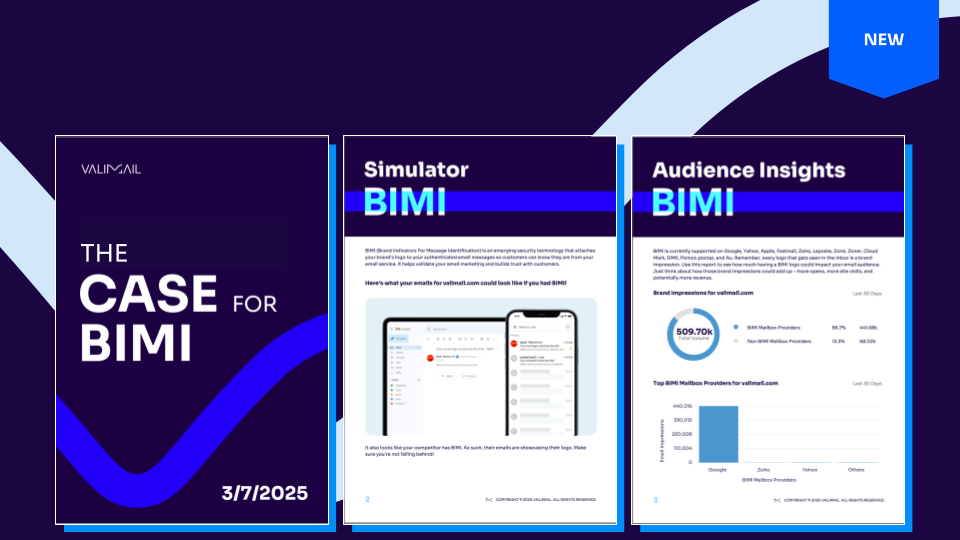
Improve your brand consistency with Valimail
BIMI is one of those rare solutions that helps both your marketing team (hello, brand visibility) and your security team (goodbye, impersonation attempts) achieve their goals. But getting BIMI right requires a strong foundation. You need:
- Properly configured email authentication
- Consistently maintained DMARC enforcement
- A VMC certificate that actually means something
That’s a lot of moving parts to manage, and that’s where Valimail comes in. We’ve helped over 92,000 companies get their email authentication right. Our Amplify platform makes implementing and maintaining DMARC at enforcement straightforward to set you up for BIMI success. And unlike stand-alone tools that leave you figuring things out on your own, we’re with you every step of the way.
Here’s what implementing BIMI with Valimail looks like:
- We get your DMARC to enforcement (the right way)
- We help maintain your email authentication
- We guide you through the BIMI implementation process
- We provide ongoing monitoring and support