
DIY DMARC is why you’re still not at enforcement
Valimail has the faster fix
Stop the spiral of broken records, SPF limits, and stalled projects: Benefit from continuous protection fast with Valimail.

Table of Contents
Out of the 50 million sending domains we track, about 6.4 million, or 11.2%, are managing DMARC on their own but haven’t started enforcing it yet.
Enforcing DMARC is hard, and not because the standard is confusing, but because your email ecosystem is. Many organizations have invested months or even years, yet still remain at p=none. When you’re juggling multiple domains, subdomains, and a rotating cast of third-party senders, publishing a DMARC record is only step one; real success requires continuous discovery, correct SPF/DKIM alignment, and the confidence to move policy forward safely.

Without automation and clear ownership, projects stall in monitor-only mode. This guide explains the pitfalls that derail in-house efforts and shows a faster, safer path to true enforcement, with Valimail doing the heavy lifting through automation and expert support.
Key takeaways:
- Monitoring isn’t protection: p=none leaves you open to exact-domain spoofing; real defense starts at quarantine/reject.
- Why DIY stalls: constant SPF/DKIM/DMARC misconfigs, third-party sender sprawl, subdomain gaps, and the SPF 10-lookup ceiling (flattening breaks).
- Instant SPF fixes SPF at scale: patented macro-based approach, with no flattening, keeps SPF accurate as services change.
- See senders by service, not IPs: clear, actionable visibility surfaces unknowns and speeds approvals.
- Enforce fast, with safety nets: central policy control to move to reject in clicks and rollback just as easily when needed.
- Automate the grunt work: alerts, guided DKIM hygiene, and no-ticket changes replace raw XML parsing and slow DNS ops.
- Experts on your side: onboarding and ongoing guidance help you reach—and stay at—enforcement across all domains and subdomains.
The real cost of stalling at p=none
Why this matters: Monitoring isn’t protection. While you’re at p=none, attackers can still send exact-domain spoofs that look like they came from you. That risk compounds the longer your domain remains stuck in “monitor only.”
What you’re up against
Even diligent teams get burned: brand-perfect phishing, executive impersonation, and fake invoices slip through because receivers aren’t instructed to quarantine or reject failures. The fallout is real: disrupted deals, refund fraud, and a flood of “was this really you?” tickets.
- Exact-domain spoofing remains easy for attackers.
- BEC and exec impersonation drive incident costs and reputational damage.

How Valimail helps
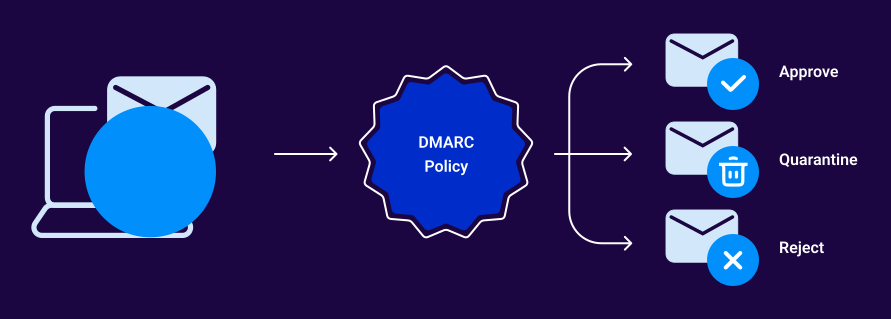
Valimail shortens the “window of spoofability” by getting you from monitor to enforcement quickly and safely.
- Click-to-enforce p=none → quarantine → reject—and click-to-rollback if needed.
- Automated sender discovery and alignment checks reduce surprises at go-live.
Expert guidance minimizes false positives and speeds cutover.
What keeps teams stuck at p=none in the first place? It starts with brittle, technical blockers.
Technical barriers: Where DIY breaks (and attackers slip in)
Why this matters: In complex environments, small misconfigurations snowball into alignment failures. DIY fixes tend to be fragile, and attackers thrive in those gaps.
What you’re up against
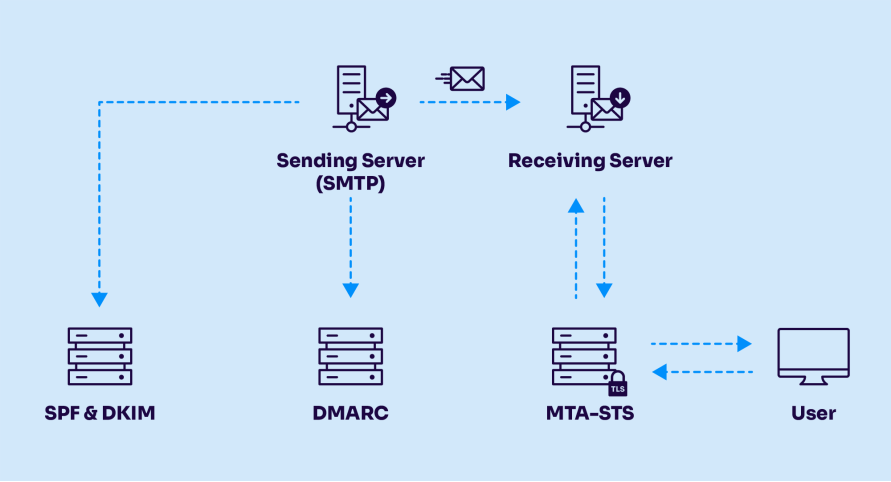
Even with smart people, maintaining clean SPF, DKIM, and DMARC across domains, subdomains, and vendors is a moving target.
- Constant misconfigurations across SPF, DKIM, and DMARC create silent failures.
- Third-party sender sprawl turns each new tool into a detective story (IPs, hosts, selectors).
- Expired or misconfigured DKIM keys pass unnoticed until delivery breaks.
- Subdomain oversight leaves exploitable gaps.
Want to check your domain’s email authentication status? Use our free domain checker to identify what security gaps you may have:
Check your
domain now
Enter your domain to see if it’s vulnerable to spoofing or if others are sending emails on your behalf. Instantly check your DMARC, SPF, and BIMI status with a detailed security report.
You’re not fully protected, learn more here.
Check your
domain now
Enter your domain to see if it’s vulnerable to spoofing or if others are sending emails on your behalf. Instantly check your DMARC, SPF, and BIMI status with a detailed security report.
You’re not fully protected, learn more here.
Check your
domain now
Enter your domain to see if it’s vulnerable to spoofing or if others are sending emails on your behalf. Instantly check your DMARC, SPF, and BIMI status with a detailed security report.
You’re not fully protected, learn more here.
Your Domain
Not protected AGAINST IMPERSONATION ATTACKS
DMARC NOT AT ENFORCEMENT
exampledomain1.com
Authentication Status for January 10, 2025
DMARC at Enforcement
SPF Record Configured
BIMI Ready
exampledomain1.com
Authentication Status for January 10, 2025
DMARC at Enforcement
SPF Record Configured
BIMI Ready
How Valimail helps
Valimail makes the foundation resilient, so enforcement isn’t scary.
- Instant SPF® removes the 10-lookup bottleneck without flattening (with our patented SPF macro approach).
- Service-level intelligence shows “Microsoft 365,” “Salesforce,” “Workday” – not just IP address numbers, so you can approve with confidence.
- DKIM hygiene at scale with guided rotation and alignment checks.
- Subdomain coverage so nothing falls through the cracks.
The single most common failure point inside “technical barriers” is SPF. Let’s zoom in.
SPF’s 10-Lookup limit: The hidden breaker (and why Instant SPF wins)
Why this matters: SPF evaluation can’t exceed 10 DNS lookups. Hitting the limit triggers intermittent failures, and the typical workaround (flattening IPs) goes stale and breaks quietly.
What you’re up against
As you add services, you creep toward the 10 lookup ceiling. Flattening looks like relief, but it’s a brittle, manual treadmill, especially when vendors rotate infrastructure.
- Hard 10-lookup ceiling leads to unpredictable SPF results.
- Flattening creates bloated, static records that decay and fail silently.
How Valimail fixes it
Valimail’s patented SPF macro, Instant SPF, solves the limit the right way, without flattening.
- Patented, macro-based approach returns the right SPF response at message time.
- Records stay lean and accurate as vendors change, eliminating brittle edits.
- Result: A durable SPF foundation that lets you keep your domain, and any number of sending services, at enforcement.
With the technical landmines addressed, the next blocker is the operational grind that keeps teams reactive.
Operational friction: Work that never ends (Unless you automate)
Why this matters: Tickets, Time To Live (TTL), change windows, and cross-team coordination add drag. Without automation, small changes consume sprints, and big changes get deferred.
What you’re up against
Every new sending service means hunting down owners, tweaking DNS, and scheduling safe windows. Meanwhile, vendor IP changes can quietly break things.
- Manual DNS changes are slow and error-prone.
- Every new service requires coordination and intervention.
- Continuous auditing becomes reactive, not preventive.
How Valimail fixes it
Valimail turns change into a controlled, fast operation.
- Central policy control: enforce (or rollback) in clicks without risky TXT surgery in your DNS.
- Owner insights and detections speed approvals and decommissions.
- Automated monitoring and alerts catch issues before they hit the business.
Even with smoother operations, you need clear visibility to act decisively.
Visibility challenges: Flying blind on XML
Why this matters: Raw XML DMARC reports weren’t designed for humans. If you can’t see who’s really sending, you can’t enforce safely.
What you’re up against
Spreadsheets and IP lookups don’t scale; “shadow IT” keeps appearing, and issues surface only after failure.
- Raw XML is overwhelming and not actionable.
- Unknown senders hide behind IPs and hostnames.
- Limited alerting means late detection.
How Valimail fixes it
Turn unreadable data into decisions.
- Readable dashboards that auto-map sending to named services and show pass/fail by alignment.
- Unknown/unauthorized streams highlighted with suggested owners for fast triage.
- Proactive alerts for new senders, failing SPF and DKIM, or policy drift.
Finally, people and process realities can stall progress even when the tech is ready.
Organizational and human constraints: Why teams stall at “monitor”
Why this matters: Fear of breaking mail is rational. Limited expertise and competing priorities make “monitor only” feel safe, but it leaves risk unaddressed.
What you’re up against
Getting to enforcement requires cross-functional alignment and confidence.
- Fear of blocking legitimate mail keeps p=none as the default.
- Limited in-house DNS, DKIM, and SPF expertise at large, distributed orgs.
- Competing priorities and scarce resources push DMARC down the backlog.
How Valimail fixes it
Lower the risk, raise the speed.
- Expert-guided onboarding from specialists who’ve seen every edge case.
- Safe, phased enforcement with easy rollback reduces go-live anxiety.
- Less to maintain: Instant SPF, service-level controls, and central policy lower ongoing effort.
Put it all together: here’s the guided path from p=none to durable enforcement.
How Valimail gets you to enforcement – and keeps you there
Why this matters:
You need a predictable, reversible path to p=reject that scales across domains and senders.
- Connect once (DMARC, SPF, DKIM) and surface every sender by service name.
- Enable legitimate services, fix failing streams, and retire unknowns.
- Delegate SPF to Instant SPF (no flattening) to remove the lookup bottleneck.
- Advance policy in stages: p=none → quarantine → reject—with monitoring and one-click rollback.
- Stay enforced with alerts, DKIM rotation guidance, and ongoing expert support.
Public sector note: For agencies and contractors, pair this with FedRAMP-authorized deployment and a mandate-aligned path to p=reject.
Proof and what changes with Valimail
Why this matters: Results beat theory. Teams move faster, with less toil and risk.
Before (in-house)
- Flattened SPF that drifts out of date
- Manual XML parsing and IP detective work
- Slow, ticket-driven DNS edits
- Permanent fear of turning on enforcement
After (with Valimail)
- Instant SPF: macro-based, no-flattening, RFC-aligned
- Service-by-name identification (not mystery IPs)
- Click-to-enforce – and click-to-rollback
- Expert-guided onboarding with a modern UI


“Managing SPF, DKIM, and DMARC manually was complex, and we frequently hit SPF record limits and authentication failures. Valimail’s automated solution took the guesswork out of email authentication, resolving our misconfigurations instantly and providing full visibility into our email ecosystem.”

Carlos Cornielle
Cloud Security Engineer at Evopoint Solutions
Talk to a DMARC expert
DIY DMARC shouldn’t take years. Let’s fix that.
If your team’s still circling around broken SPF records and half-finished enforcement projects, it’s time to call in reinforcements.
Schedule a free consultation with a Valimail expert and learn how to replace flattening with Instant SPF, map your senders, and plan a safe path to p=reject with easy rollback built in.
Additional resources
Explore more on DMARC, email authentication, and phishing prevention with these expert insights. Whether you’re just getting started or fine-tuning your enforcement strategy, these resources will help you secure your domain and stay ahead of emerging threats.

Frequently asked questions about DIY DMARC
As the global leader in DMARC and email authentication, Valimail has helped over 90,000 organizations secure their domains and stop impersonation attacks. In this section, we answer the most common questions and FAQs so you can protect your email domains with peace of mind.
Will Valimail block legitimate email?
Our approach identifies senders by service, pairs that with Instant SPF and DKIM continuous protection, and guides a phased cutover to quarantine/reject. If something surprises you, you can roll back policy in a click, adjust, and re-enforce just as easily.
How does Valimail beat the SPF 10-lookup limit?
Instant SPF uses SPF-standard macros and patented runtime logic; it does not flatten IPs. That’s why it stays accurate as vendors change and avoids silent failures.
Can Valimail’s platform handle lots of subdomains and senders?
Yes. You’ll get access to a centralized policy, service owner insights, and alerts that scale across complex portfolios.
We’re in the public sector; should we do anything special?
Use a FedRAMP-authorized solution and plan for p=reject; Valimail provides an expert-guided, reversible path that meets mandate expectations.
Get started for free
with Monitor
Start your path to DMARC enforcement with a panoramic view of the traffic being sent on your behalf.
No trial offers, credit cards, or obligations.
Explore all Valimail
has to offer
Go one step further than visibility…Take action! Reach DMARC enforcement faster. Stay compliant with evolving sender requirements. All while protecting your brand.